
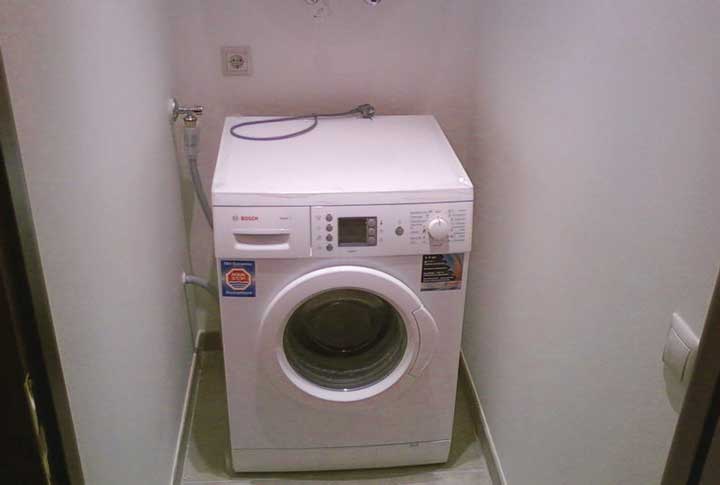
 Buying a high-quality and durable washing device is only half the battle. Most people call the master from the service center, but we want to suggest that you do everything yourself. You should follow a certain algorithm of actions, which will consistently, step by step, tell you how to properly ground the washing machine without grounding in the apartment.
A bit of theory
Most consumers do not assume the existence of such a problem as the lack of grounding and use the device for its intended purpose, not realizing that they can endanger their loved ones electric shock. Only when you feel the shock of an electric current with a voltage of the nth number of volts, you will understand that grounding the washing machine will save you from many troubles.
Prerequisites for installing earthing:
 There is a high chance of injury - at first you will tremble and tingle a little, but this is a warning signal.
- There is an opinion, which is confirmed by professional electricians with considerable experience, that in the absence of grounding, all household appliances may fail before the declared service life. , as a result of which you or have to pay an expensive repairOr even buy a new washing machine.
If suddenly at a certain moment you began to notice that your light bulbs in the apartment began to burn out much more often than usual after purchasing a washing device, then you should know that this is the first wake-up call that you should make grounding.
But before you are going to make grounding for the washing machine in the apartment with your own hands, 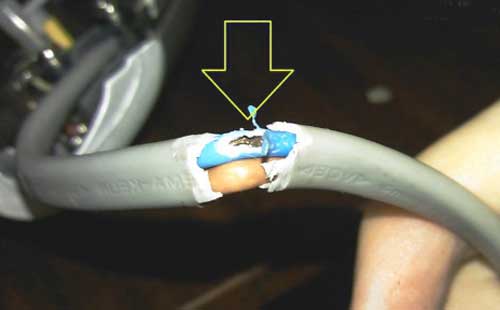 . Quite often there were cases when electric shock occurred precisely because of damage to the insulating protection of the wires, so in this case, grounding will not be able to solve all the problems at once.
If in your home there are connected stationary electric stoves, then in your house there is 100% grounding, because the existing 3rd drive is responsible for this. In this case, you are incredibly lucky, and you don’t have to do anything.
home method
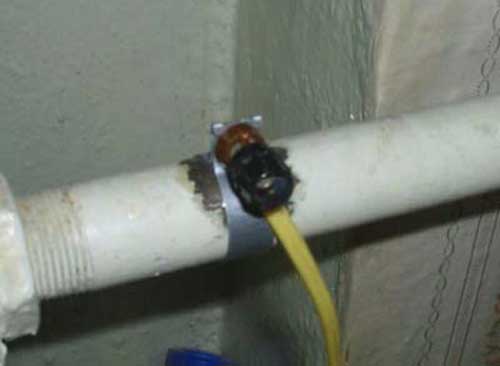 When there were those times in which all houses had only metal pipes for heating and plumbing, our grandfathers (and some great-grandfathers) came up with a very interesting, but effective method: install grounding in the apartment, connecting all electrical appliances to the battery.
The method was wildly popular and was widespread almost everywhere in the middle of the 20th century.
True, and here it was not without drawbacks:
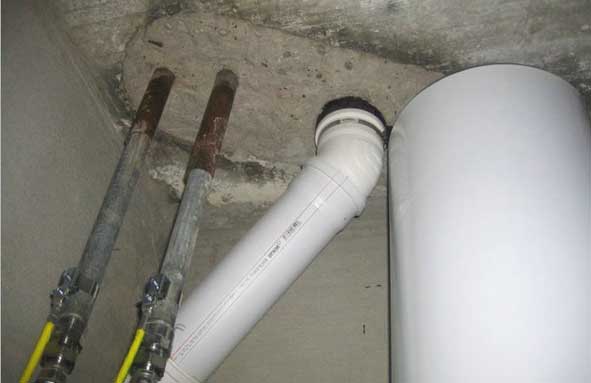 The legality of this method is very doubtful, because the conduct of such operations was contrary to the rules of work specified in GOST.
- The occurrence of problems with pipes and batteries during their long-term use as grounding. Some "users" of this system noted that over time, their pipes began to leak.
- A small percentage of reliability and a rather high risk of injury from electric shock.
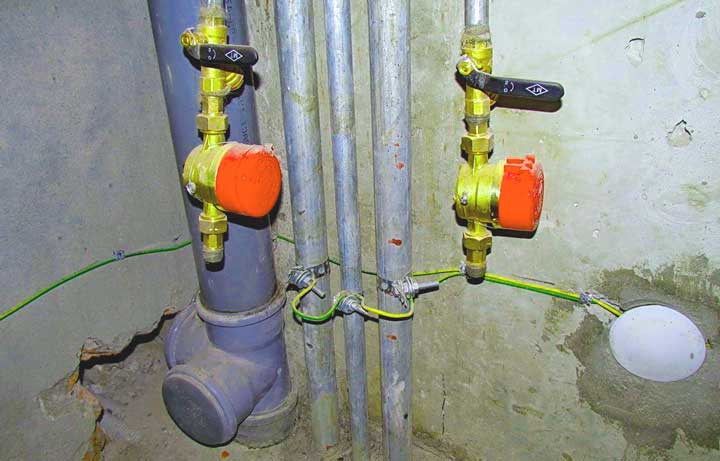 But, oddly enough, this does not scare some people at all: for them, the most important thing is that everything is convenient and inexpensive for them, so they buy a single-core copper wire, strip it from both sides and make such a connection that on our territory they still so far is illegal.
To do this, you will need to install an additional outlet with the desired shape for the washing machine, and a three-core wire will be connected to your shield
Thus, many people, with their own hands, sign the verdict on the sudden flooding of neighbors, which will occur due to a breakthrough in the heating system, which is used for the wrong purposes.
As you can see, such a connection of a washing machine without grounding can end in failure.
Grounding through the electrical panel
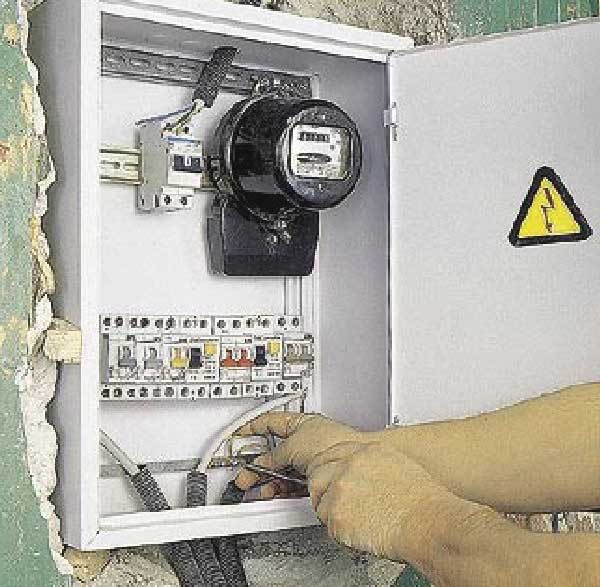
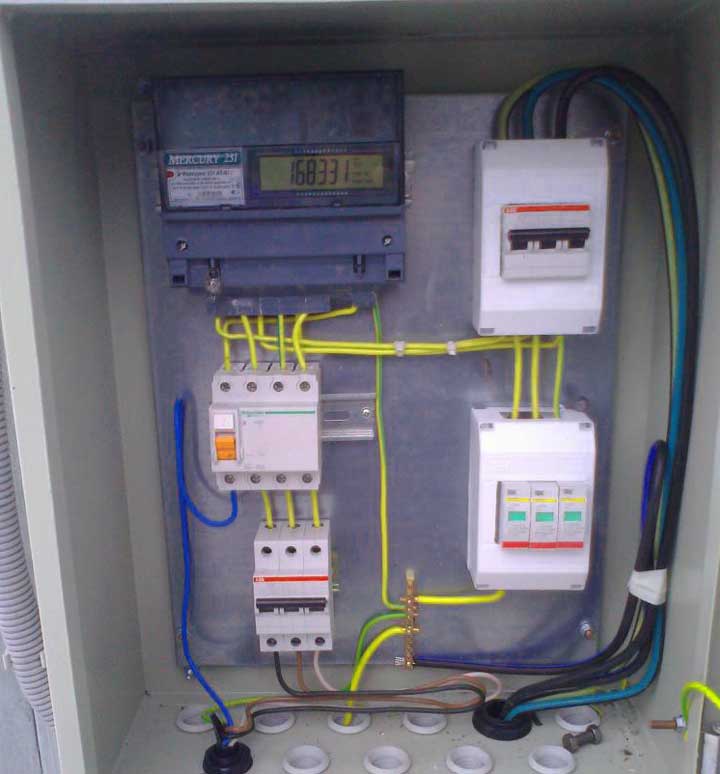 It is best to ground the washing device through a stationary electrical panel - this will be the most efficient and quite cultural.
To do this, you will need to install an additional outlet with the desired shape for the washing machine, and a three-core wire will be connected to your shield, where the ground will be installed.
To carry out this kind of work, we need only a few tools:
- Dielectric screwdriver.
- Pliers with insulated handles.
- Sharp utility knife or wire stripper.
- Insulating tape.
All veins should be connected only to certain places - two tires and a certain switch that works in automatic mode.
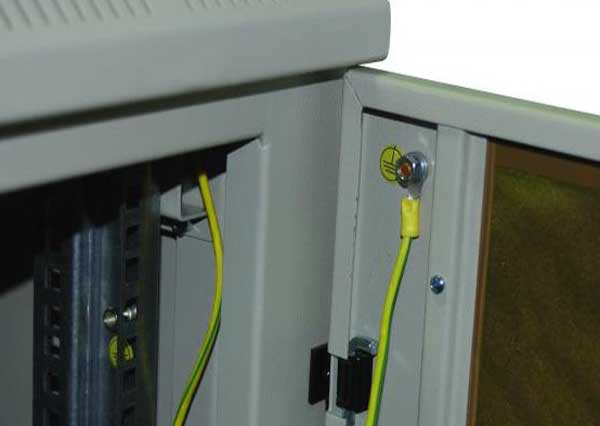 Otherwise, you should seek the help of a highly qualified electrician.
The financial costs will not be so big (and what is important - one-time, because, as you know, “the miser pays twice”), and the guarantee of safety for your life and the service life of household appliances will be 100%.
When doing work with your own hands, remember:
- Each standard electrical panel has 2 tires - zero (N) and for grounding (PE). Only from them is the wiring done.
- Having made the necessary wiring, connect the wire as follows: we connect the blue wire to the null bus (N), the red wire through the residual current device with the phase of your meter, and the green-yellow wire to the PE bus.
Grounding in your home
If you have a private house, then solving the issue of grounding the washing machine is quite simple. Own house is, first of all, a fortress where the owner of the house can do whatever he wants (without violating GOSTs, of course).
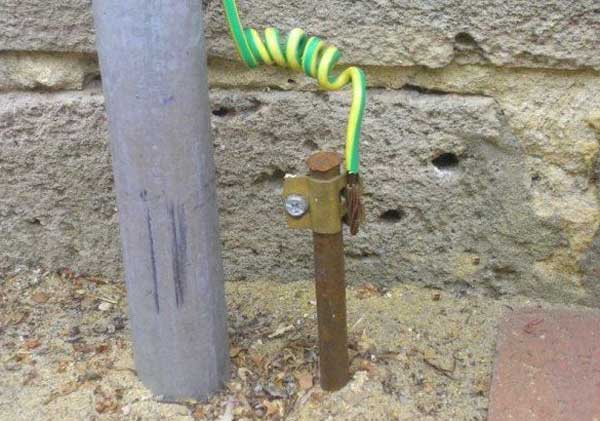 Internal wiring is done by analogy with the above algorithm of actions, and the connection is made through a working electrical panel. Your house has a huge number of advantages in installing grounding yourself, because the area near your house is only yours and no one will object to installing the structure.
A step-by-step list of actions for how to make grounding in an apartment with your own hands:
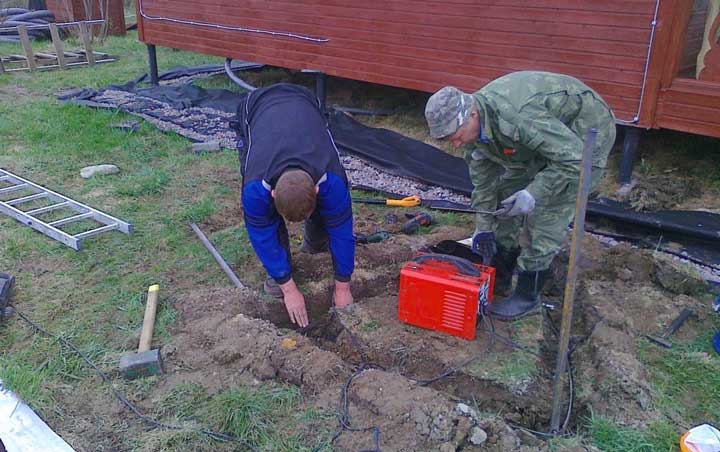
- Prepare 3 pieces of water pipe (can be old) about 1.5 meters long - lengthmax should not be less than the depth to which the earth freezes in winter.
- One end should be sharpened so that you get a conical saw cut, and then we drill holes that will reach 0.5-1 s in diameter at a height of 1/3 from the bottom end.
- Prepare a hole up to 0.6 meters deep and 1.5 * 1.5 meters wide.
- Drive in the pipes at a distance of 1-2 meters from each other, forming a triangle so that the top horse is 0.15 meters higher than the bottom of the pit.
- Next, take the fittings (or corner), cut into three parts, measure at the ends of our pipes already hammered into the ground and connect everything into a single whole.
- A ground wire must be welded to the upper part, which comes from the electrical panel located in the house.
- This wire, which must be made of a metal wire with a large cross section (at least 5 mm), is connected to the PE bus.
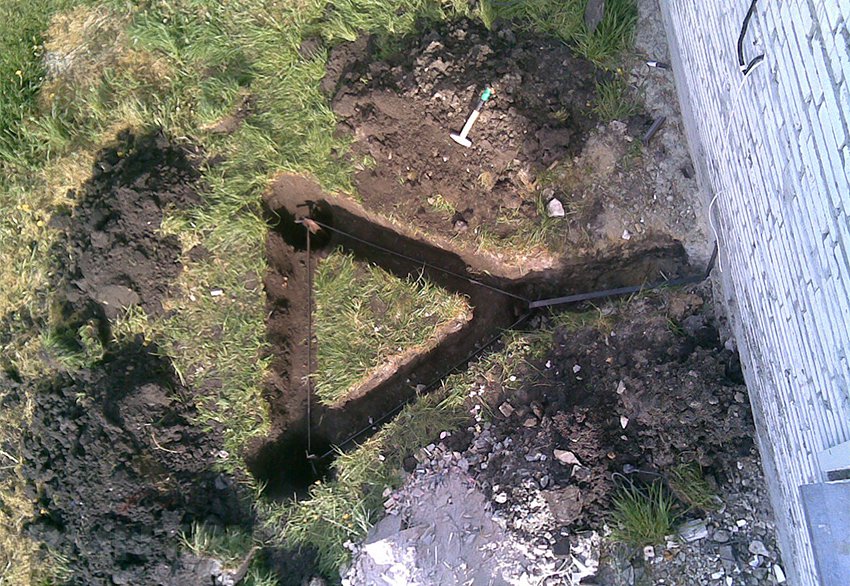 Now, when the grounding of the entire network is done, you need to fill in the hole and lay the turf on the place allocated for it, we designate the dimensions of our structure in any way that is acceptable to you.
In the summer, when the heat begins, you need to water your hole at least once a week with a solution of salt (about 0.5 kg per large bucket of water). If the air temperature is less than 30 degrees Celsius, then watering is done once a month. This way you will ensure a uniform distribution of stress in the ground.
And in conclusion, one more small and important tip: it’s better to do it once, but reliably, than to do it quickly and do it anyhow, but then regret that you couldn’t save expensive equipment from breakdowns.
Should household appliances be grounded
 Most consumers have some doubts about the appropriateness of grounding, but we hasten to assure you that for safe use, all appliances in the house should be grounded - from an electric kettle to a washing machine, refrigerator and expensive TV.
In modern houses or newfangled new buildings there is a stationary grounding - its presence is easy to determine by special three-phase sockets.
The houses of early buildings were not equipped with grounding, and therefore the wire had to be laid on its own. Therefore, it is worth grounding the washing machine and how best to do this will always be a topical issue.
Here are some examples for those who are still in doubt:
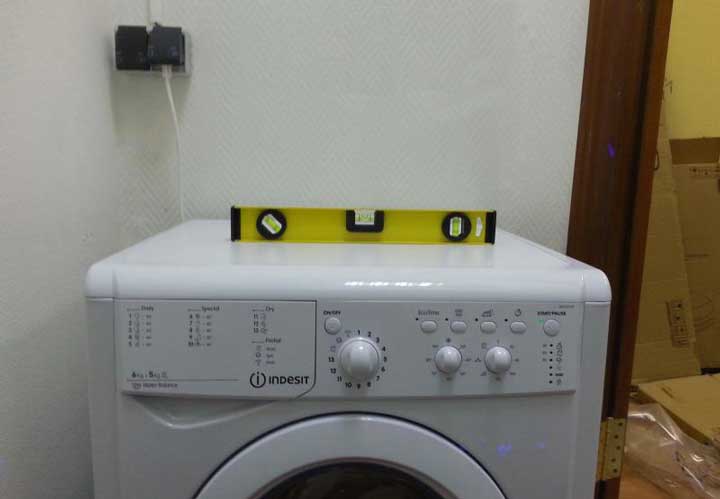 A machine with a built-in surge protector, when connected to a network in which there is no voltage, will accumulate a voltage of 110 V on the case, and when you touch it, you will feel a rather noticeable tingling sensation.
- If the insulation of the wires is broken, 220 V will accumulate on the case. So, touching the kettle, you will get an unforgettable shake. If the device is installed in a place where water will be spilled on the floor (you will act as a conductor), this can be fatal.
 And if you also live in such a house on the third floor, then pulling the wire to yourself is practically unprofitable.
Here you will be rescued by the system of equations of potentials. It is quite understandable and is based on the fact that all objects that work on electric current or can conduct it are connected into one system using metal wires.
Thus, if you simultaneously touch corps washing device, and, say, a mixer, then the current will not pass through the body.
The desired condition is to install a separate knife switch on your washing machine, so that in case of some unforeseen failure, it immediately disconnects itself from the network.