 Modern automatic washing machines show us from the outside as a reliable design, quite functional and durable.
Unless, of course, there are various types of malfunctions and misuse on the part of the owner.
As they say, “Nothing lasts forever”, because even the most “cool” and expensive washing machines can be broken. Let's look at a few common problems and how to fix them.
- Major breakdowns and their causes
- The machine does not turn on
- Door won't open
- Handle broke
- Blockage due to water
- Software problems
- No water intake
- No water heating
- Checking the heating element
- Thermostat check
- Voltage test
- Drum does not rotate
- Spin problems
- Stopping the washing machine after rinsing
- The machine does not reach a certain speed
- The problem is a broken motor tachometer
- There is no water drain. Details
- Prevention
Major breakdowns and their causes
The machine does not turn on
A more common problem is when the washing machine does not turn on. You need to take the following steps:
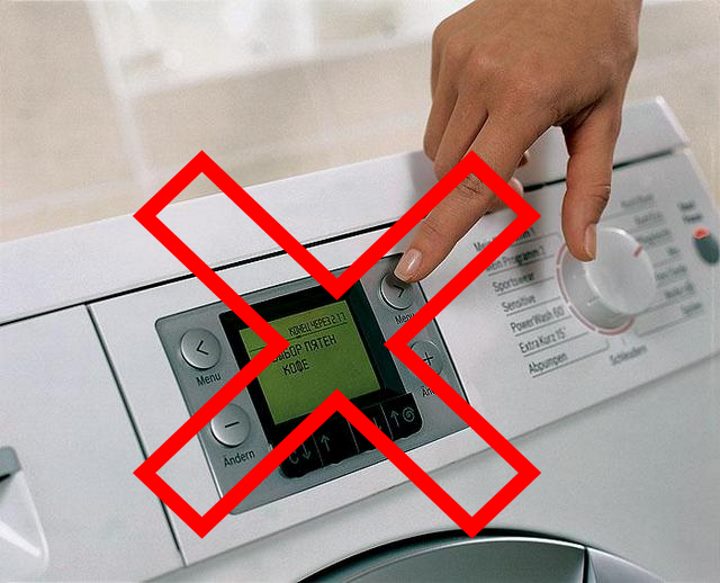 Make sure your washing machine is plugged in.
- Make sure the outlet has power. To check the voltage, plug another electrical device into it or check it with an indicator screwdriver.
- Check if the loading door is closed tightly. To check, first open and then close it, you can hear it by clicking.
Door won't open
A related problem may be that the door does not open. The failure may be of a mechanical nature, such as a broken handle.
Handle broke
To eliminate this breakdown, we will perform several steps:
 It is required to remove the top cover of the washing machine, and for this you need to unscrew the fixing screws in advance.
- Tilt the body back so that the tank moves slightly away from the front of the washing machine.
- Put your hand inside the structure from above and unlock the latch with your own hands.
You may need to replace the door handle itself. To do this, unscrew the fixing screws around the perimeter of the door, and remove the upper half (front). Next, you should pull out the idle (old) handle and replace it with a new one, and then repeat the same steps in reverse order.
Many models of automatic washing machines are equipped with a special "cable" that produces an emergency unlocking of the doors. Its location is under the lower front panel. The cable (in many cases) is orange in color, pull the cable (gently) and the door will open.
Blockage due to water
Also, the door of the washing machine may be closed due to the presence of water in it. Washing machines have their own safety technology that can automatically close the door to eliminate the risk of flooding. This action is displayed as an "elementary consideration" of technology.
Software problems
There is such a problem as a non-working program.
If nothing happens after loading the laundry and trying to start the program, the following options are possible:
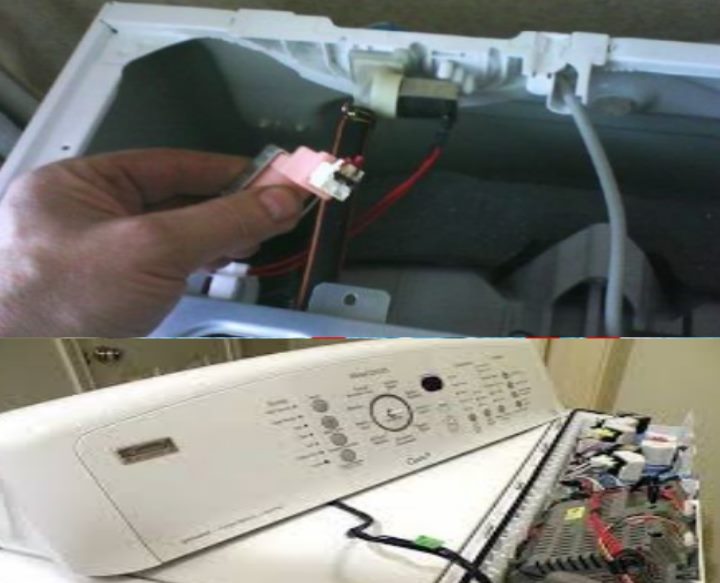 The machine is disconnected from the network;
- Problem with the power cord;
- The network filter is disabled;
- Problems with the door lock;
- Power circuit problems;
- Network button not working.
Further effective steps to address these causes:
- You should press the power button of the washing machine, or turn the program selection knob.
- Make sure,
– that the washing machine is plugged in;
– that there is voltage in the socket;
– that the power cord is not damaged;
– that the cord plug is not damaged. - Unscrew the fixing screws located on the reverse side of the washing machine (rear) and remove the cover.
Press and test (ring) the power button with a tester.
If the contact is missing or disappears, the button needs to be replaced.
Additional steps to eliminate the cause of the failure of the washing machine:
- Check the input filter with a tester. The filter is located in the upper part of the unit near the supply wire.
- Also, if the indicator lamps start to light up when the washing program is selected, then the problem may be in the door lock device. If there is no blocking when energized, the blocking device must be replaced.
- You need to check the lock blocker for a signal.
This requires checking the integrity of the wires and loops, checking the control board for defects, measuring the voltage in all elements of the circuit.
Failed components must be replaced. - Perhaps you could find a breakdown in the central microcircuit. In this case, the control board is subject to replacement or flashing.
It is best to deal with this type of problem with the help of a specialist.
No water intake
The problem may also be that the washing machine does not draw water. Then the possible problems and their solutions are described below.
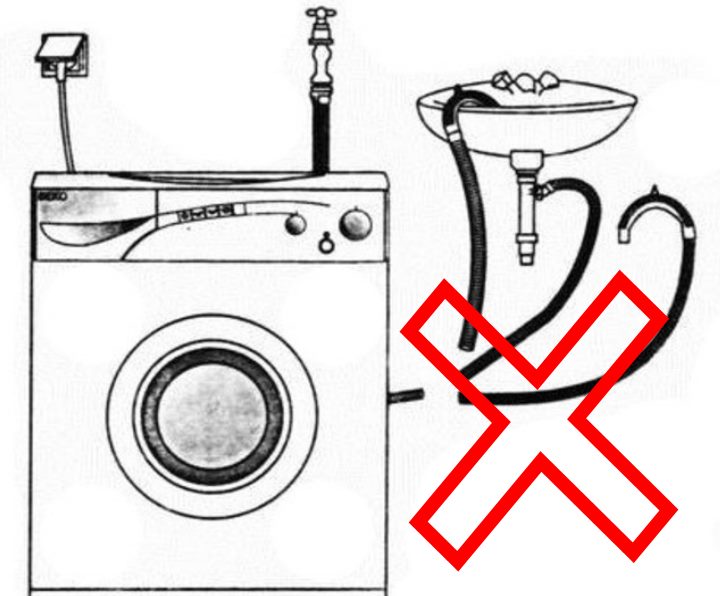 A certain amount of water does not enter the powder compartment or not enough.
The problem can be easily solved - just disconnect the inlet hose and stick out the filter mesh, then rinse it thoroughly.- Constant water drain.
The cause of this problem may be the incorrect connection of the water inlet and outlet hose. Checking the hose and correcting any problems found is required. - The solenoid valve is worn out.
Over time, the membrane of this element wears out, and, accordingly, its throughput system becomes worse. The solution to the problem is to replace the valve. - The water level sensor is inoperative.
The location of the sensor is slightly above the drum of the washing machine. The pressure hose needs to be disconnected and purged. Just blow into it and if you hear clicks, then the sensor is operational, if not, this element needs to be replaced.
No water heating
The problem may be that the water in the washing machine does not heat up.
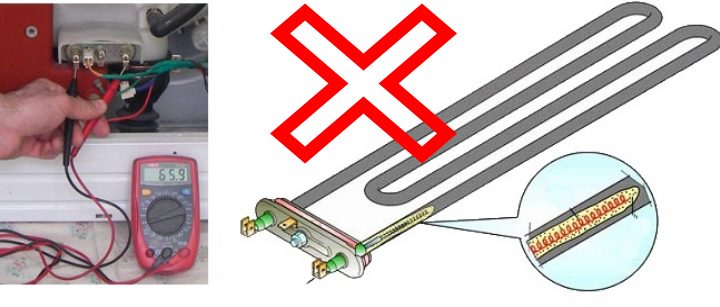 If your washing machine does not heat up, then you can safely assert that this is a failure of the heating element (heating element). With this reason for the breakdown of the washing machine, do not rush to immediately begin repairs. It is better to pre-carry out several diagnostic steps:
- You should check the tank for the presence of water in it;
- Make sure that the correct washing program is selected, which involves heating the water to more than 40 degrees;
- Make sure that when turning on the automatic washing machine does not knock out plugs;
If the glass heats up, then the heating element is not damaged and everything is operational, if not, then proceed to the next steps.
Checking the heating element
This heating element is located at the bottom of the tank. Using a tester, determine the resistance indicator for a break.
If the element is defective, you need to contact the service with an application for a replacement device. There is a possibility that the reason is due to scale on the heating element.
It can be eliminated with the help of special tools that are sold in hardware stores.
Thermostat check
Using a tester, measure the resistance values. Defective sensors should be replaced with similar elements.
Voltage test
Using a tester, measure the voltage supplied to the heating element
Drum does not rotate
The case may be in the drive belt, or rather in its integrity - it can be stretched, or simply damaged. In this case, only knowledge of radio engineering (if any) will help you solve this problem, but if not, we do not advise you to take risks, but immediately contact the service with qualified specialists.
Spin problems
 If your washing machine has a breakdown of this type, then in principle there is nothing to worry about, since fixing a malfunction of this kind is not difficult.
When the spin cycle occurs, it is not the tank that spins in the washing machine, but the drum. The first step is the distribution of laundry, then the drum speed increases, at this moment you can set which of these stages the problem occurs.
By the method of elimination, we will go through everything in stages, from the most simple and common to the more obvious and complex.
Stopping the washing machine after rinsing
The laundry you take out of the tub is still wet.It is necessary to clean the filter, because due to the debris that gets there, the drain process worsens and for this reason the washing machine cannot fully wring out the laundry.
The machine does not reach a certain speed
Basically, the reason lies in frayed brushes. In this case, you can notice extraneous sounds, or the smell of burning during the washing process. If the working reach of the brushes is seen to be less than 0.7 cm, they must be replaced, which can be done as follows: simply disconnect the wire, pull out the contact and pull out the brushes, after remembering the direction of the graphite contacts.
The problem is a broken motor tachometer
If the set speed does not match the set program, the washing machine engine can only run at minimum or maximum speed.
The tachometer monitors the speed of rotation of the rotor and controls it. In the process of rotation, an alternating voltage appears on the terminals of the coil.
To compare the frequency in the washing machine system, a certain board is provided, which also controls the rotation of the drum. You can solve the problem in an easy way: just tighten the screws that secure the sensor.
There is no water drain. Details
Washing machine can hold water in the tank due to clogged pipes.
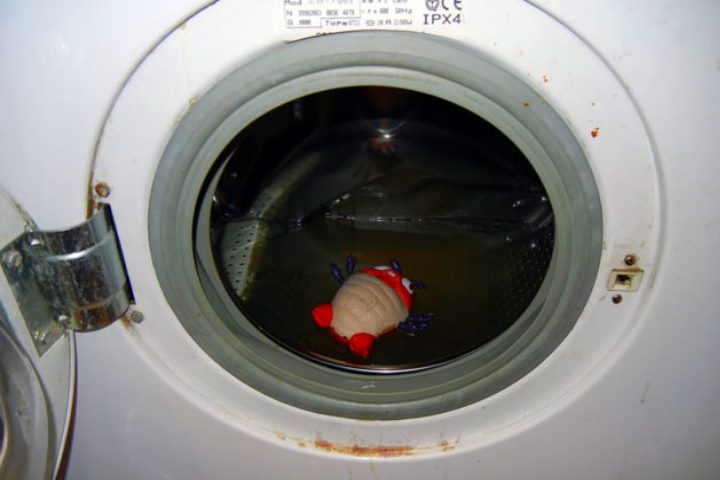 We recommend using a bath or a toilet.
The hose will clear as soon as you turn on the spin or forced pump.
Also affects the flow of water filter, the status of which needs to be checked periodically.The filter is located at the bottom of the washing machine body, in the front.
Its location is on the left or right side, under the decorative panel (which can be easily removed), or under the hatch cover.
In order to open the hatch, you need to insert any flat object that is suitable in width into it (a screwdriver is perfect for this). The panel can be fixed with latches or screws. Modern automatic washing machines have a thin drain hose that can be pulled out and lowered into a container.
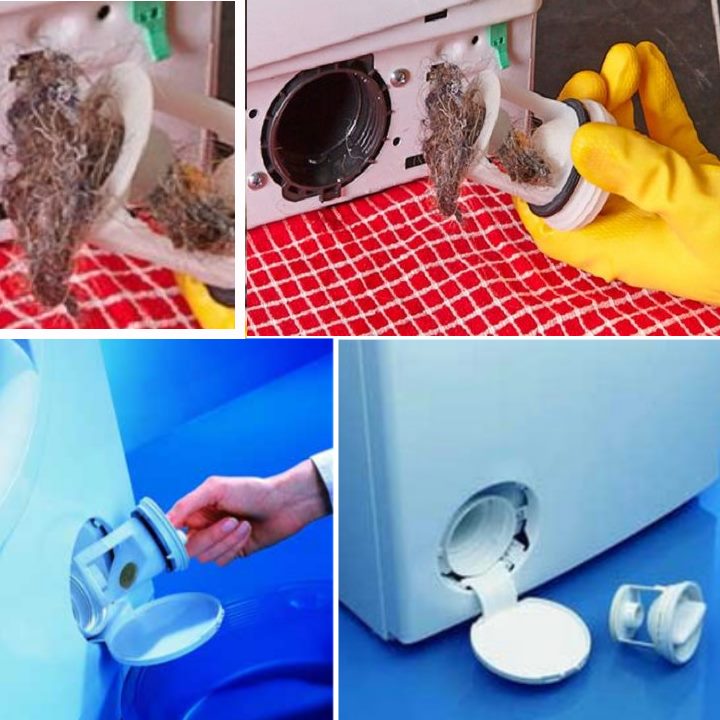 If the location of the filter fixation is found, it should also be unscrewed. To do this, in the center of the product there is a special bulge that allows you to grab the filter with your hand. In some cases, the filter does not lend itself.
If it is the same in your case, use pliers and use them very carefully to unscrew the filter counterclockwise. In order not to damage the filter and not scratch it, you can wrap it with a cloth beforehand. Once you unscrew it, carefully clean the filter from dirt and third-party objects.
If after these steps water does not flow out of the washing machine, you need to check for clogging of the tank and pump, or rather their connections. If problems are found, clean the nozzle. Using a screwdriver and pliers, you can easily remove the clamps.
Need to make sure it's correct pump. To do this, turn on the spin and look at the pump blades, which should rotate freely.
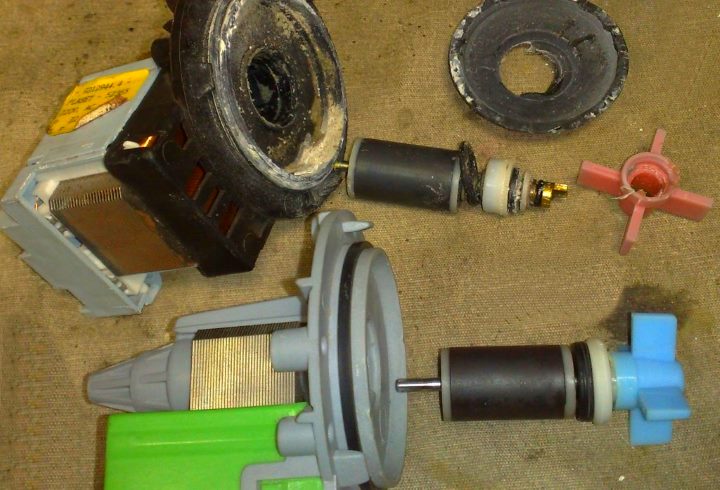
If they do not rotate, or rotate slowly, unplug the washing machine and inspect the hole where the blades are located for any kind of dirt or malfunction.
Once you have checked and cleaned the blades, you can turn on the pumping of water in the washing machine again.If after all the procedures the blades did not work, then the reason may be hidden in a broken motor, which can only be replaced by a service department.
Prevention
Do not overload, use it carefully.
Periodically clean the filters (we recommend using special powders) and sometimes contact the service for prevention.