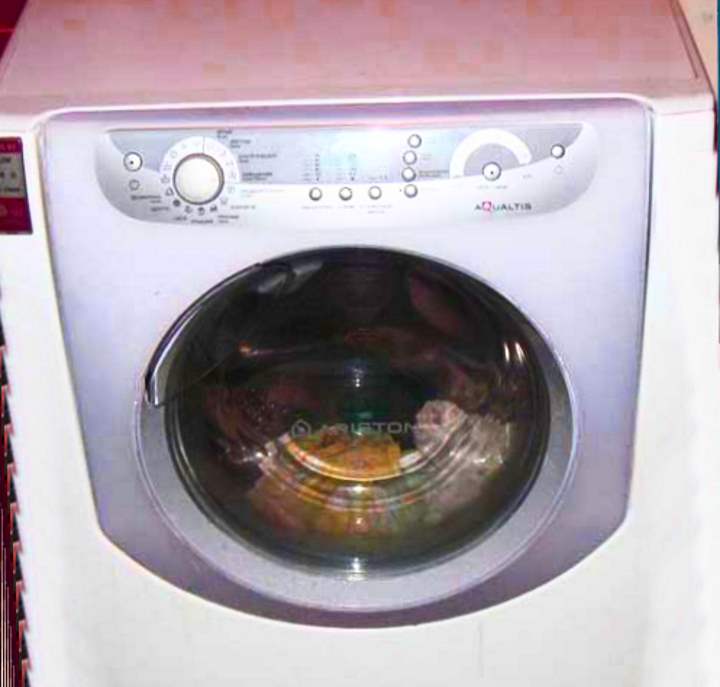
 There are a huge number of models of washing machines in the modern market of household appliances. All of them differ in power, control, volume, color, etc.
But each of them can be attributed to one of the two available categories: activator or tympanic.
Of course, there are many more drum models and their popularity is enviable, because they are more economical and careful. But their minus is that they are capricious and often fail.
What are the likely breakdowns?
Common breakdowns include:
- water leakage from under the bottom;
- “freezing” washing machines;
- strong noise and vibration;
- water intake without drain;
- The washing machine fills with water but does not wash.
Let's stop at the last point.
The machine draws water, but does not wash
The machine is turned on, the laundry is loaded, the washing program is running, and even a set of water has already taken place, but that's bad luck ... the washing process is over and the washing machine does not wash. She seemed to be stuck! The drum does not spin, the washing machine does not react to anything.
What happened? But it could happen:
- Complete drum stop.
- Breaking heating element.
- The motor has failed.
- Bearings flew.
- belt fell off.
- Faulty control module.
Let's take a closer look at each reason.
Drum lock
This is a mechanical failure and if the interfering object is removed, the problem will be solved.
Heating element failure
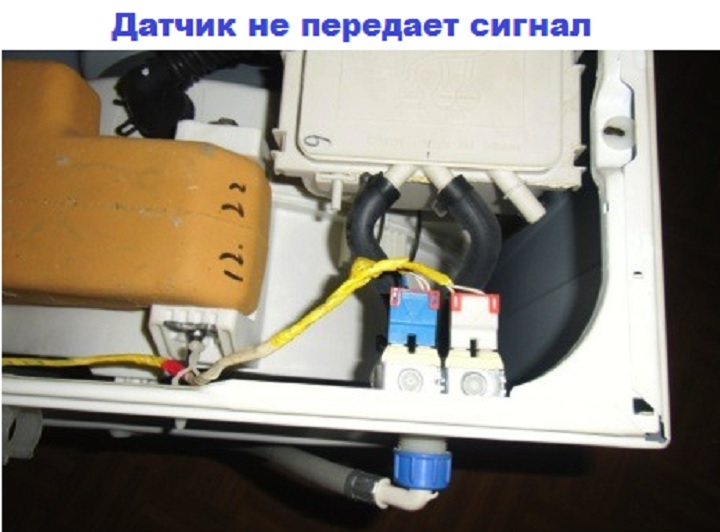 This is probably strange, but yes, problems with heating element affect the performance of the drum and a situation arises when the washing machine draws water, but does not wash.
The engine does not receive a command from the sensor to start. In turn, the sensor cannot fix the desired heating temperature.
It turns out that the motor cannot turn on, and the drum, respectively, too. To check and inspect the heater, you will need to remove the back cover of the washing machine or the front, depending on the model.
The heating element is located at the bottom of the tank. To get it, the wires are removed and the nut is unscrewed in the middle of the heating element. If black spots are visible on it, most likely it has broken through and needs to be replaced.
If there are no visible malfunctions, diagnostics by a tester will be required.. When in good condition, the resistance should be from 20 to 40 ohms, otherwise less than 20. Install the heating element back carefully.
Washing machine motor failure
Most often, only the brushes have to be replaced in the motor, and not the entire part. To change the brushes, you will have to remove the engine, and from it all the sensors and the belt. Armed with a screwdriver, the terminal on the brush is removed. To pull out the brush, a plate is inserted into the hole, folded over and pulled out.
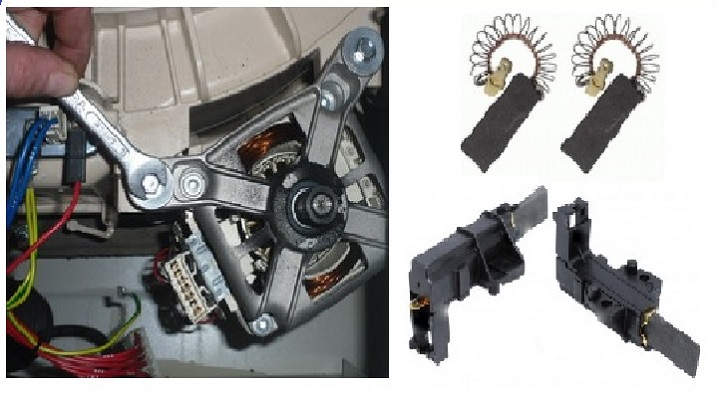 The same actions will help to get another brush.Insert a new brush into the brush holder, press it with a spring and fix it. All. Unless, of course, we are talking about an asynchronous motor, where brushes are not provided.
For such engines, the capacity of the starting condensate is mainly lost and it does not have enough current to start, naturally, there can be no talk of speed.
In this case, replacing the capacitor will save. Less often you have to rewind due to engine burnout. There are situations when the engine cannot start due to overheating and then the washing machine fills with water and does not wash. Usually the reason is the launch of several washes in a row.
Bearing failure
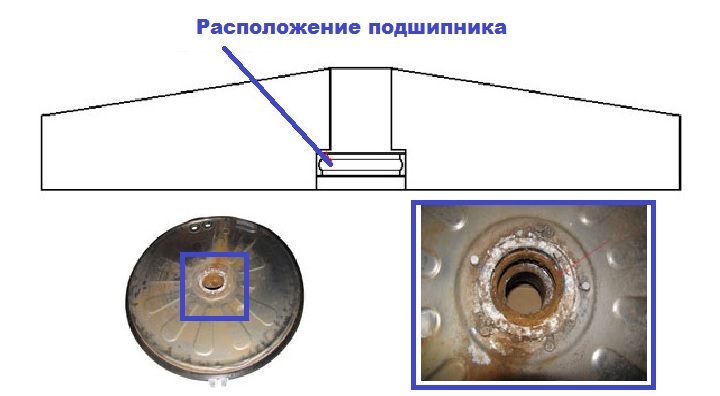 Before bearings are hard to get, they are located in the very center of the washing machine tub. Thanks to them, the drum rotates.
If the bearings have fallen apart, the washing machine will notify you with a clear creak and noise during operation, and will also knock.
Untimely replacement threatens with a more serious repair, since a broken bearing is able to break the belt and damage the drum.
Drive belt not working
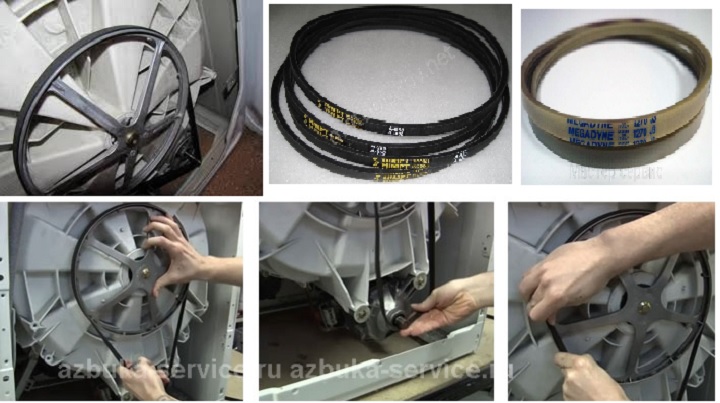 Washing machine draws water, but does not wash - diagnostics can be safely started with a belt, unless of course the washing machine is not a direct drive.
A common cause of belt problems is regular overloading of equipment with linen. Constant loads on the drum axis loosen it and wear out the belt, which can deform or even break the part.
It happens that the belt flies when transporting equipment. We'll have to disassemble the washing machine and check the suspicions. The belt is installed behind the rear cover for front loading, and for vertical loading behind the side. If the belt is fine and just fell off the pulley, that's not a problem.Otherwise, you will need to replace the torn belt with a new one.
To dress or replace, simple steps will be required. Take it out of the washing machine and check for defects. To put it on, you must first put it on the engine, then pull it up with one hand, and put it on the pulley with the other. To fix the belt, turn the pulley counterclockwise and put the belt on it.
Control module failure
You will need diagnostics and testing of the module on a special stand, because it is difficult to determine by eye what burned out on the board if there are no black marks on the parts and tracks. Even if there is, professional board soldering will be needed. The work is painstaking. Without experience and skills, there are high chances of buying a new board and replacing it with the old one.
How to identify the problem yourself
There are simple and uncomplicated points that you can identify and try to fix yourself. You yourself can:
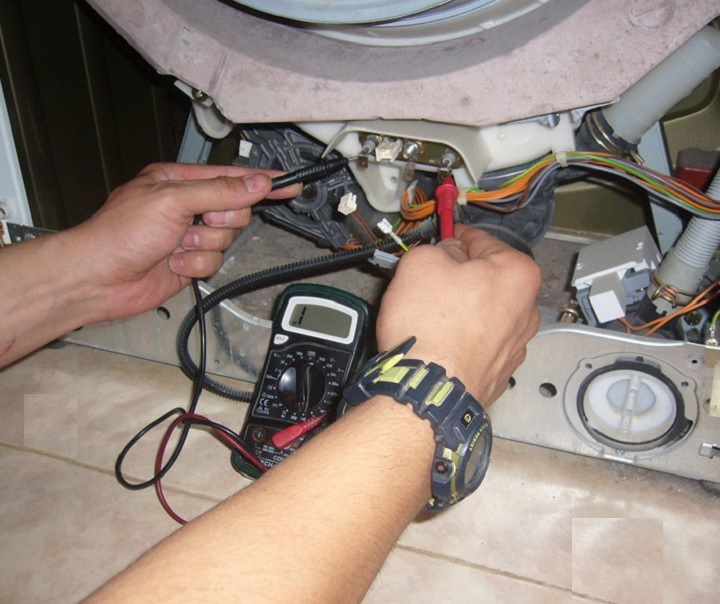 If you have a tester, you can check the heating element (heater) and the engine. If a strong spark is visually noticeable, you will need brush replacement. When buying them, you need to consider the type of engine of your washing machine.
- Emergency drain water from the washing machine using a special valve or hose if the washing machine has filled with water, but does not wash.
- Visually inspect the tank and drum for foreign objects stuck between the parts. To do this, you will have to remove the side walls of the washing machine. If an interfering object is found, it simply needs to be removed.
- You can check the drive belt yourself. If it just flew off, you need to put it in place so that there is a margin of 1 prong. And if it is torn, then it is necessary to replace the part with a new one.
If you do not know what happened to the washing machine, for what reason it does not work, then it would be best to contact the service.
To prevent this kind of breakdowns, it is enough just:
- do not overload the drum with laundry,
- install overcurrent protection
- use a filter, because many people know in which water it is better to wash and what consequences the neglect of this fact can lead to.




Hello!
Please tell me what is the malfunction in the indesit wil85 washing machine.
The machine works in the spin, drain, rinse modes, and when the washing mode is turned on, complete silence. Doesn't throw any errors. Please reply to email if possible.
Sincerely, Alexander.