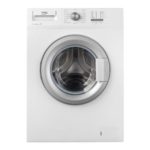
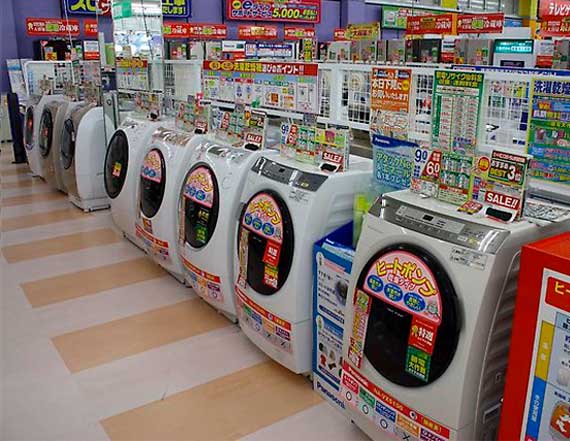
 In the modern market, washing machines of German, Japanese and Korean production have gained great popularity. They differ in quality, set of options, price and distribution, brand significance.
In terms of wear resistance, Korean ones are clearly losing to Japanese washing machines. However, they are not very popular in the Russian market.
Washing machines are classified according to the type of laundry load. vertical and frontal. Firstly powder when washing, it is poured directly into the drum, and secondly there is a special compartment.
Consider the features of Japanese washing machines
The Japanese are a clean people, so they are very scrupulous about the neatness of clothes.
Their washing machines:
- Do not heat water, except for the modern and most expensive. The maximum water temperature is usually +30 degrees. This is due to the fact that they have drinking water flowing in the water supply, when combined with the powder, everything is washed off perfectly!
- All of them have a drying mode.
- Very short drain hose, but all washing machines are installed on a drip tray - leakage protection. True, this water cannot be drained into the water supply.
- The technique is mainly used with a vertical type of loading.With frontal - the most modern, Europeanized technology.
- Expensive: $1,000 - $2,000.
Where to buy them?
- From hands
- In the online store
What else applies to Japanese production?
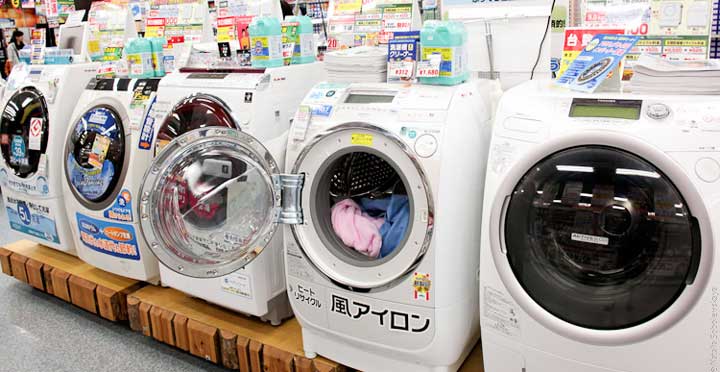 Washing machines Panasonic, Sharp, Shivaki, Akai, Hitachi.
! Be careful !
Under the name of a well-known brand, Chinese or Russian-made equipment can be sold.
Consider a couple of models from Japan
Akai AWD 1200 GF
Advantages:
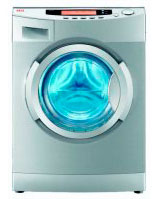 Freestanding washing machine with drying function.
- Front loading.
- Drum capacity for washing 6 kg, for spinning 3 kg. Spin 400-122 rpm.
- 11 washing modes.
- Water consumption 42 liters.
- High efficiency and energy class A, spin B.
- Almost silent washing process.
- Convenient interface, the ability not only to set modes, but also to adjust depending on the volume of laundry, the degree of contamination.
- Equipped with functions such as child protection, delayed start, water level control, ironing, disinfection.
Flaws:
- Strong vibration of the centrifuge.
- Poor stacking of laundry before spinning, the noise of this process.
Premium washing machine Panasonic NA-16VX1
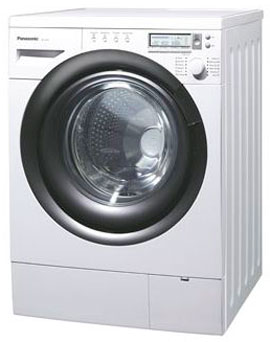 Advantages:
- Front loading type.
- Drum capacity for washing 8 kg, for drying 4 kg, maximum spin 1,500 rpm.
- 14 washing modes.
- Water consumption is about 44 liters.
- High class of efficiency and extraction category A.
- Reduced noise level during spinning and washing.
- Large display with 3D sensor
- The main advantage is the Beat Wash technology: the drum has an inclination of 10 degrees, due to which things wrinkle less and do not twist. Water flows in small streams, which effectively cleanses the fabric.
- It is equipped with a number of useful functions: control over the state of its components, protection against voltage surges, partial protection from leaks, also from children, easy ironing and stain removal.
The only and main drawback: dimensions - 60x60x85 cm (WxDxH), which can make it difficult to transport and transfer.
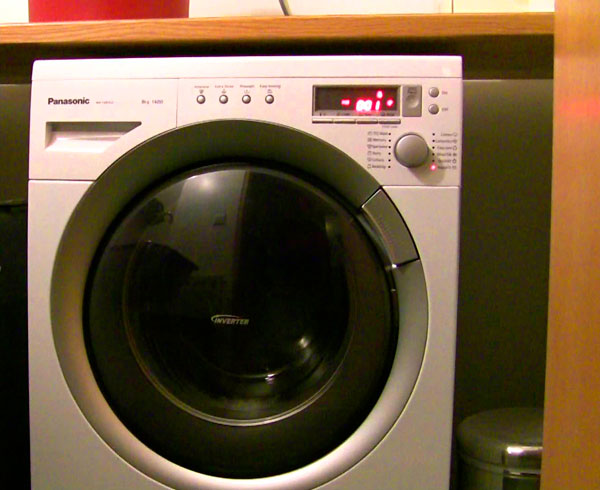 Panasonic NA-14VA1. It has a lot of similarities with the previous model. Let's call Additional features:
- It is built under the countertop, due to the removable top cover.
- Special drum angle + water supply from three sides, which improves the washing result, provides convenient loading and unloading of laundry.
- The 3D sensor helps to adapt the washing process to the characteristics of the fabric, ensuring the most gentle washing.
Japanese Panasonic washing machines are good because they are tested for strength and endurance before release. They are tested 24 in a row, tests show that they can withstand 5,000 washings, and the hatch door can be opened from 2,000 times. So their reliability is guaranteed.
What to wash? Consider Japanese washing powders
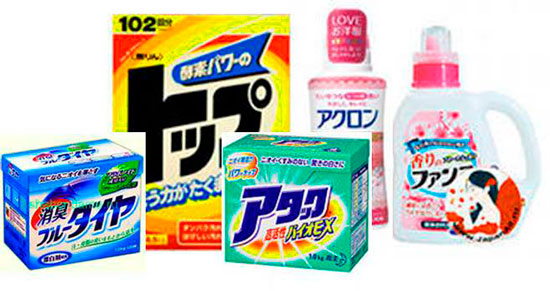 For the washing machines described above, washing powders such as Lion, Attack, PAO Win Wash Regular are ideal. Japanese detergents are easily washed out of the fabric, hypoallergenic. They do not contain phosphates, surfactants, optical products.
Also, they do not contain dyes and fragrances, flavors and any petroleum products.Consist of plant components, which helps to remove long-stubborn stains, such as wine, sweat, oils (including machine oil), berry juices, etc. In addition, they are not tested on animals and are completely safe for humans, why rightly become environmentally friendly products. Suitable for both machine and hand wash.
Another significant advantage is the gentle effect on any fabrics, both natural and synthetic. It is also noteworthy that Japanese powders retain their original appearance and saturation of things longer, including white ones.
According to the form of release, they are powder, liquid, helium and tablet, according to their purpose: special, universal and auxiliary.
 Means are considered special separately for colored, white linen, certain types of fabrics, universal are means suitable for almost all fabrics, except for delicate ones. Auxiliary agents include agents to enhance the quality of washing during the process or after, for example, conditioners, stain removers, softeners, etc.
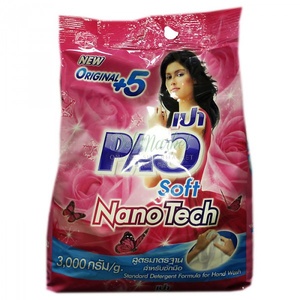
The PAO product line is based on the latest Japanese technology, while being completely safe - environmentally friendly. Being without aggressive chemical elements, PAO detergents penetrate deep into the fibers of the fabric thanks to plant components.
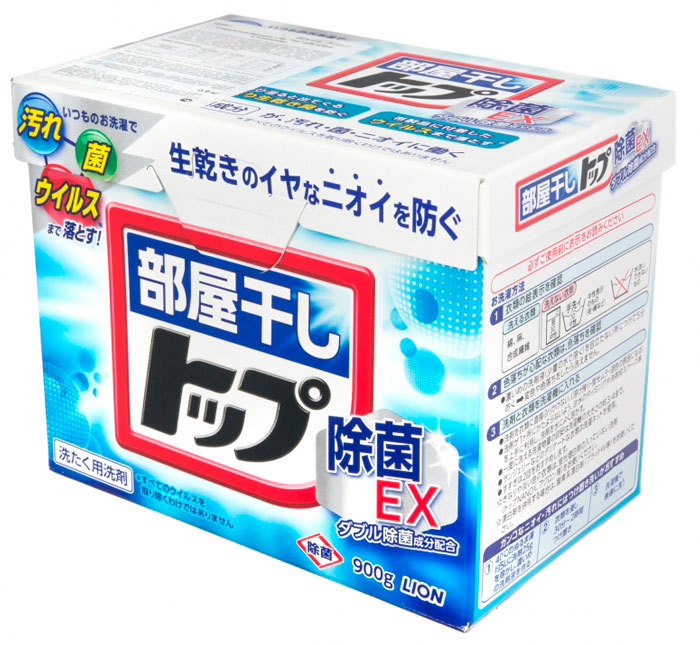
Lion powder is available in convenient and compact packages. The agent itself is not volatile. Unlike Russian analogues, a measuring spoon is attached to it, which greatly simplifies use.
A huge plus is also its efficiency, despite the higher price, it is spent much less than the funds of other manufacturers. Another plus is: the release of other forms of environmentally friendly household chemicals.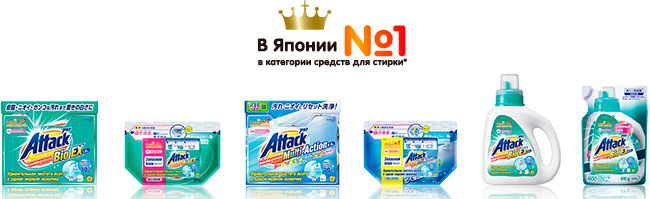
The Japanese brand Attack is the leading retailer in Japan. In addition to all these advantages, washing powders of this production quickly dissolve in water, prevent yellowing of linen and eliminate musty odors.